
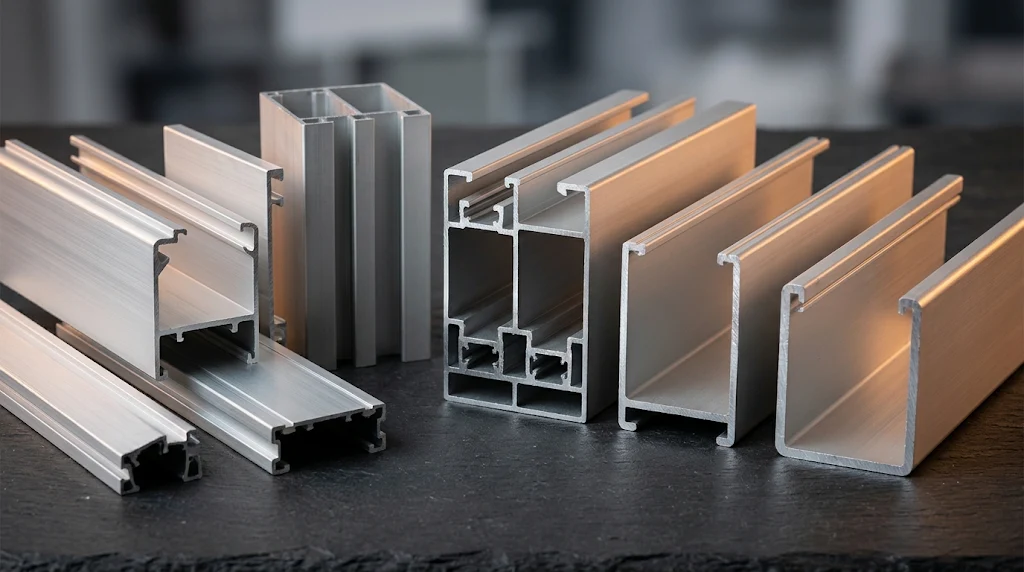
Selecting the right aluminium alloy and temper designation directly affects structural load capacity, surface finish quality, CNC machinability, and total project cost. Whether you are procuring solar mounting rails, architectural sliding window frames, frameless glass railing channels, or hydraulic door closer housings, matching the alloy to the mechanical load is essential.
Quick Comparison: Common Aluminium Extrusion Alloys
| Alloy & Temper | Primary Strength Advantage | Surface & Anodizing Quality | Recommended Extrusion Series |
|---|---|---|---|
| 6063-T5 | Balanced strength with high extrudability for complex multi-hollow dies | Excellent architectural finish | Door & Window Series, Architectural Hardware Profiles |
| 6063-T6 | Higher yield and tensile strength via solution heat treatment | Very good finish with higher rigidity | Heavy Sliding Windows, Frameless Glass Railing Channels |
| 6005-T5 | Superior structural load capacity and bending resistance | Good industrial finish | Solar Module Mounting Structures (C-Rails, Short Rails, Clamps) |
| 6061-T6 / 6082-T6 | High mechanical strength, pressure tightness, and CNC machinability | Industrial structural grade | Hydraulic Door Closer Bodies, Heavy Industrial OEM Sections |
1. 6063-T5 vs 6063-T6 for Architectural Doors, Windows & Hardware
The 6063 series is the global benchmark for architectural fenestration because it flows smoothly through intricate multi-chamber extrusion dies while maintaining tight dimensional tolerances.
- When to specify 6063-T5: Ideal for standard 2-track and 3-track sliding window profiles, casement shutters, cabinet handles, and wardrobe hardware sections where crisp corners and smooth surface aesthetics are the top priority.
- When to specify 6063-T6: Recommended for tall commercial window spans, high-rise facade profiles, and heavy-duty sliding doors exposed to higher wind-load deflection.
Explore section weights and dimensions in our Door and Window Series Catalog and Hardware Series Catalog.
2. Why 6005-T5 & 6063-T6 Dominate Solar Module Mounting Structures (MMS)
Utility-scale and commercial rooftop solar PV installations must withstand 25+ years of outdoor corrosion and cyclonic wind uplift without permanent rail deformation.
- 6005-T5 Alloy: Offers higher yield strength than standard 6063-T5, allowing solar EPC contractors to optimize purlin spans on C-rails and trapezoidal rooftop short rails without excessive wall thickness.
- 6063-T6 Alloy: Widely used for mid-clamps, end-clamps (30mm, 35mm, and 40mm panel frames), and walkway support channels where precision slot tolerances ensure fast module clamping on site.
Download technical drawings and unit weights (kg/m) from our Solar Module Series Catalog.
3. Structural Alloys for Frameless Glass Railings (12mm to 21.52mm Glass)
Balcony and staircase glass railings act as cantilevered structural barriers. Because lateral line loads concentrate at the base U-channel, softer tempers can flex over time. Specifying 6063-T6 or 6061-T6 for continuous U-base channels and top-mount/side-mount balustrade profiles ensures rigid glass clamping and long-term safety compliance. View available base profiles in our Glass Railing Series Catalog.
4. Zero-Porosity 6061-T6 & 6082-T6 for Hydraulic Door Closer Bodies
Hydraulic door closer housings require dense, void-free internal grain structure so pressurized hydraulic fluid never seeps through cylinder walls after precision CNC boring and honing. Extruded 6061-T6 and 6082-T6 billets provide superior internal soundness compared to cast housings, reducing CNC rejection rates for hardware OEMs. See specifications in our Door Closer Series Catalog.
Summary Checklist Before Ordering Your Extrusion Die
- Define the structural load: Use 6063-T5 for standard architectural frames, 6063-T6 for glass railings and tall spans, and 6005-T5 or 6061-T6 for high-stress solar and industrial housings.
- Verify wall thickness & unit weight (kg/m): Balanced wall thickness prevents die deflection and keeps per-meter procurement cost predictable.
- Share CAD drawings early: Submitting
.DWGor.DXFfiles lets our tooling engineers optimize hollow web geometry before die cutting.